Showing posts with label Soils. Show all posts

Monday, September 28, 2015

Learn free Civil Engineering by Civilustaad about SOIL CLASSIFICATION

http://civilustaad.blogspot.com/

SOIL CLASSIFICATION
The Unified Soil Classification System (USCS) is a soil classification system used in engineering and geology to explain the texture and grain size of a soil. 


The classification structure can be applied to most unconsolidated materials, and is represented by a two-letter symbol. Each letter is described underneath (with the exception of Pt):


If the soil has 5–12% by weight of fines passing a #200 sieve (5% < P#200 < 12%), both grain size distribution and plasticity have a major effect on the engineering properties of the soil, and dual notation may be used for the group symbol.


 For example, GW-GM corresponds to "well-graded gravel with silt."


If the soil has more than 15% by weight retained on a #4 sieve (R#4 > 15%), there is a considerable amount of gravel, and the suffix "with gravel" may be added to the group name, but the group symbol does not change.


For example, SP-SM could submit to "poorly graded SAND with silt" or "poorly graded SAND with silt and gravel."


Tuesday, September 15, 2015

Learn Free Civil Engineering by Civilustaad about CELLULAR CONFINEMENT SYSTEMS (CCS)

http://civilustaad.blogspot.com/

CELLULAR CONFINEMENT SYSTEMS (CCS)

Cellular Confinement Systems (CCS) also known as geocells—are extensively used in construction for erosion control, soil stabilization on even ground and steep slopes, channel protection, and structural reinforcement for load support and earth withholding.


Characteristic cellular confinement systems are made with ultrasonically welded high-density polyethylene (HDPE) strips or Novel Polymeric Alloy (NPA)—and expanded on-site to form a honeycomb-like structure—and packed with sand, soil, rock, gravel or concrete.


Learn free Civil Engineering by Civilustaad about TRAFFIC VOLUMES

http://civilustaad.blogspot.com/
TRAFFIC VOLUMES

In telecommunication networks, traffic volume is an appraise of the total work done by a resource or capacity, normally over 24 hours, and is measured in units of erlang-hours. 


It is defined as the product of the average traffic power and the time period of the study.

Traffic volume = Traffic intensity × time


A traffic volume of one erlang-hour can be caused by two circuits being occupied constantly for half an hour or by a circuit being half occupied (0.5 erlang) for a time of two hours. 


Telecommunication operators are crucially interested in traffic volume, as it openly dictates their revenue.


Sunday, September 13, 2015

Learn free Civil Engineering by Civilustaad about What is Green Building?

http://civilustaad.blogspot.com/
What is Green Building?

Green Building is a building practice that builds upon sustainable natural and environmental principals creating an improved indoor and outdoor environment.


Green building includes a broad array of stages in building throughout its life cycle from land- use, building design, and construction strategies that work to reduce unfavorable environmental consequences. Conventional buildings and construction practices characteristically neglect environmental consideration and often create twice the amount of carbon dioxide than the average car per year. The EPA estimates that the typical house is responsible for producing 22,000 pounds of carbon dioxide annually. According to the U.S. Department of Energy there are more than 76 million residential and nearly 5 million marketable buildings in the U.S. today accounting for one-third of the nation’s energy use and two-thirds of all the electricity? 


The turnover of green building includes:
Augmented energy efficiency

Enlarged water efficiency

Conservation of natural resources

Use of non-toxic materials

Improved indoor air quality

An improved indoor environment


Improved cost-effective performance


Tuesday, September 8, 2015

Learn Free Civil Engineering by Civilustaad about Waffle mat?

http://civilustaad.blogspot.com/

What is Waffle mat?


Waffle mat is a concrete foundation forming system used on unrestrained soil and on other types of soil where larger slab rigidity is required. Waffle mat creates a outline of deep voids on the underside of concrete foundation slabs. The voids are created with Waffle boxes that are made with recycled plastic. Concrete is poured over the Waffle boxes to form the slab, and to form a chain of slim beams in two directions between the Waffle boxes. The beams have center-to-center dimensions that do not exceed 4’-2”, and that carry the foundation openly on the soil. They make a extremely rigid foundation slab.


It’s significant to observe that a 4” thick concrete slab with closely spaced beams, as used in the Waffle mat foundation, is much added rigid than a 4” thick concrete slab with extensively spaced beams, as is commonly used in Texas.


It’s significant to observe that a 4” thick concrete slab with closely spaced beams, as used in the Waffle mat foundation, is much added rigid than a 4” thick concrete slab with extensively spaced beams, as is commonly used in Texas.


Note: Foundations using the Waffle mat system ought to be designed by a licensed Civil or Structural engineer skilled in the design of concrete foundations on expansive soil, using soil test information provided by a licensed Geotechnical engineer.


Learn free civil engineering by civilustaad about WATER SUPPLY AND SANITATION

http://civilustaad.blogspot.com/

WATER SUPPLY AND SANITATION
 

Worldwide, almost 1 billion people are deficient in clean drinking water. 2.4 billion People have no access to clean sanitation facilities; 1.2 billion lack some sanitation facilities at all. Each day, an average of 5,000 children die owing to water and sanitation connected diseases. In 2000, through the Millenium Development Goals (MDGs), the global community dedicated to halving the proportion of people without access to clean water and basic sanitation by 2015. On the whole, the world is on way to meet the water MDG, but there are foremost gaps in many regions and countries, mainly in Sub-Saharan Africa. On current trends, the world will miss the sanitation target by a overwhelming 1 billion people.

Meeting the MDG water and sanitation targets is more than a health and dignity matter. The proof is compelling that achieving the water and sanitation goals would trigger a major hurdle forward in human development:


Water and sanitation are necessary to achieving all of the MDGs
Investment in water supply yields an average economic return of $4.4 to $1
Investment in sanitation yields an typical economic return of $9.1 to $1.

Human Development is further closely connected to access to water and sanitation than other development drivers UNDP has examined, including expenditure on health or education, and access to energy services.


The crisis in water and sanitation tremendously affects the poor. Availability of water is surely a concern for a number of countries. But the global water and sanitation crisis is largely rooted in poverty, power and inequality, not in physical accessibility. It is, first and foremost, a disaster of governance and thus governance reform must be a key pillar of any tactical approach to addressing the crisis.


Learn free civil engineering by civilustaad about WATER SOFTENING

http://civilustaad.blogspot.com/

WATER SOFTENING


It's easy to not recall how significant water is in our lives. Of course we need it in our diet, but in our homes, it's a tool--a fluid standard that carries material from one position to the next. In addition to one of the reasons it does this job well is that it's extremely good at holding things, either by suspending them or dissolving them.


Unlike most apparatus, though, water doesn't come with an instruction manual. If it did, you'd know why the dishes you thought were washed are covered with spots when dry, why the water in your shower leaves a film on everything it touches, and why what you consideration was clean water has clogged up your plumbing scheme.


Learn free civil engineering by civilustaad about CORE TEST OF CONCRETE

http://civilustaad.blogspot.com/

Learn free civil engineering by civilustaad about CORE TEST OF CONCRETE

CORE TEST OF CONCRETE


Core test is normally required in the area of concrete industry to assess the concrete strength and occasionally it becomes the exceptional tool for safety review of existing concrete structures. Core test is consequently introduced in most codes. An general literature survey on diverse international codes’ provisions; including the Egyptian, British, European and ACI is done.


Learn free civil engineering by civilustaad about CIRCULAR CURVES IN SURVEYING

http://civilustaad.blogspot.com/

Learn free civil engineering by civilustaad about CIRCULAR CURVES IN SURVEYING

In the geometric intend of motorways, railways, pipelines, etc., the plan and setting out of curves is a vital aspect of the engineer’s occupation. The preliminary design is typically based on a succession of straight sections whose positions are defined mainly by the geography of the area. The intersections of pairs of straights are then linked by horizontal curves.


In the vertical design, intersecting gradients are linked by curves in the vertical plane.


Circular curves are used to link intersecting straight lines (or tangents). Circular curves are implicit to be concave. Horizontal circular curves are used to transition the alter in alignment at angle points in the tangent (straight) portions of alignments. An angle point is called a point of intersection or PI station; and, the change in alignment is definite by a deflection angle, Δ.


Types of Circular Curves are:

Simple Curve
Compound Curves
Reverse Curves
Broken Back Curves


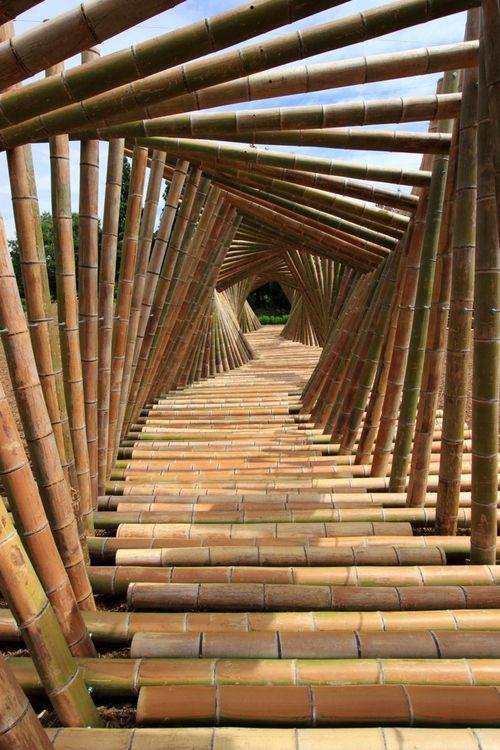
Learn free civil engineering by civilustaad about BAMBOO BRIDGE

http://civilustaad.blogspot.com/

Learn free civil engineering by civilustaad about BAMBOO BRIDGE

Sustainable building materials are universally and have been used in construction for many years. Their uses have been mainly particular until now, but as society moves to a “greener” inspection, their applications and versatility have increased significantly. In addition to the advances before now made, their efficient uses should continue to increase and spread over time with improved sustainability awareness and with additional enhancements
to technology.


One area for growth is the use of these materials in green bridges. Sustainable materials have turned out to be more common in the construction of buildings, but using these resources for bridge construction has been least. Through the course of this lessons many materials that can be categorized as sustainable were examined, but bamboo will be the center of attention of this report because of its plenty and overall versatility.


Bamboo is a naturally occurring sustainable material, which is ideal for green construction for many reasons. It grows similarly to grass so it is a construction material that is readily available. This makes it easy to harvest with minimal demolition to the
environment. It has many physical uniqueness that make it perfect for finishing aspects of building projects.


Learn free civil engineering by civilustaad about a Creative house located in Durban, Southafrica

http://civilustaad.blogspot.com/

A HOUSE LOCATED IN DURBAN

A house located in Durban, South Africa has a distinctive and innovative design, where the shape is very unconventional and internal decoration combines two styles of modern and conventional. Houses designed by Elmo Swart Architects named Wright House. This house conversion project by the architect made a number of changes in the form of an added room 3 bedroom traditional, art gallery, entertainment freedom and a fresh bedroom.


The mixture of old and new designs are actually creates a sensitivity of spectacular for anybody who saw it. How not to plan a house before the overhaul that looks less passionate then with slight modifications by adding modern style to this house makes it more passionate. Surprisingly two different styles can be combined into a beauty.