Showing posts with label CUBE CONCRETE TEST. Show all posts

Monday, September 28, 2015

Learn free Civil Engineering by Civilustaad about SHOTCRETE

http://civilustaad.blogspot.com/
SHOTCRETE
Shotcrete is, in effect, an edition of a cast-in-place concrete wall. Rather than placing concrete into forms, nevertheless, a fresh mix is sprayed onto wall panels that have been erected in the form of the building. 


A nozzle-man applies concrete from a pressurized hose to include the reinforcement and build up the wall thickness, forming structural shapes that include walls, roofs, floors, and other assemblies. 


This material has also been called “gunite” in reference to the nozzle or “gun” used to shoot matter at the form face. 
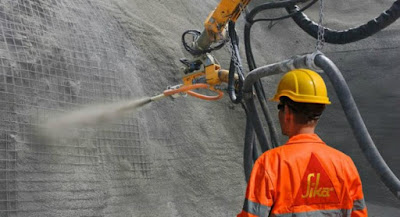

Any surface appropriate for accepting fresh concrete can be used: steel, wood, and polystyrene are common. 


Finishes are frequently applied directly to the concrete while it is still wet.

Learn free Civil Engineering by Civilustaad about SELF COMPACTING CONCRETE

http://civilustaad.blogspot.com/

SELF COMPACTING CONCRETE
Self-compacting concrete (SCC) is considered by several experts to be the greatest breakthrough in concrete technology for many decades due to the enhanced performance and working environment. 


It all started around 1988 at Tokyo University with Prof. Okamura and his students, among others Ozawa and Maekawa, as they established the fundamental description of SCC. 


Before that, numerous cases of application were known in which the concrete did not need external consolidation to obtain essential compaction and could consequently be considered as SCC, without being defined as such.


Sunday, September 27, 2015

Learn free Civil Engineering by Civilustaad about FINE AGGREGATE

http://civilustaad.blogspot.com/
FINE AGGREGATE
It is the aggregate the majority of which passes 4.75 mm IS sieve and contains only so much coarser as is permitted by specification. According to source fine aggregate might be described as:


Natural Sand– it is the aggregate resulting from the natural breakdown of rock and which has been deposited by streams or glacial agenciesCrushed Stone Sand– it is the fine aggregate created by crushing hard stone.
Crushed Gravel Sand– it is the fine aggregate formed by crushing natural gravel.


According to size the fine aggregate may be described as coarse sand, medium sand and fine sand. IS specifications categorize the fine aggregate into four types according to its grading as fine aggregate of grading Zone-1 to grading Zone-4.


The four grading zones become gradually finer from grading Zone-1 to grading Zone-4. 90% to 100% of the fine aggregate passes 4.75 mm IS sieve and 0 to 15% passes 150 micron IS sieve depending upon its grading zone.

Saturday, September 26, 2015

Learn free Civil Engineering by Civilustaad about CUBE CONCRETE TEST

http://civilustaad.blogspot.com/
CUBE CONCRETE TEST
Compressive strength of concrete: Out of many test applied to the concrete, this is the extreme significant which gives an thought about all the characteristics of concrete. By this single test one judge that whether Concreting has been done correctly or not. 

 For cube test two types of specimens either cubes of 15 cm X 15 cm X 15 cm or 10cm X 10 cm x 10 cm depending upon the dimension of aggregate are used. For most of the works cubical moulds of size 15 cm x 15cm x 15 cm are normally used.


This concrete is poured in the mould and tempered correctly so as not to have any voids. After 24 hours these moulds are removed and test specimens are place in water for curing. The top surface of these specimens should be made even and smooth. This is done by putting cement paste and spreading easily on whole area of specimen.


These specimens are tested by compression testing machine after 7 days curing or 28 days curing. Load should be applied steadily at the rate of 140 kg/cm2 per minute till the Specimens fails. Load at the crash divided by area of specimen gives the compressive strength of concrete.